Olympiad tester
Human Body – Online Encyclopedia for Kids
Human Body – Online Encyclopedia for Kids
Couldn't load pickup availability
Share
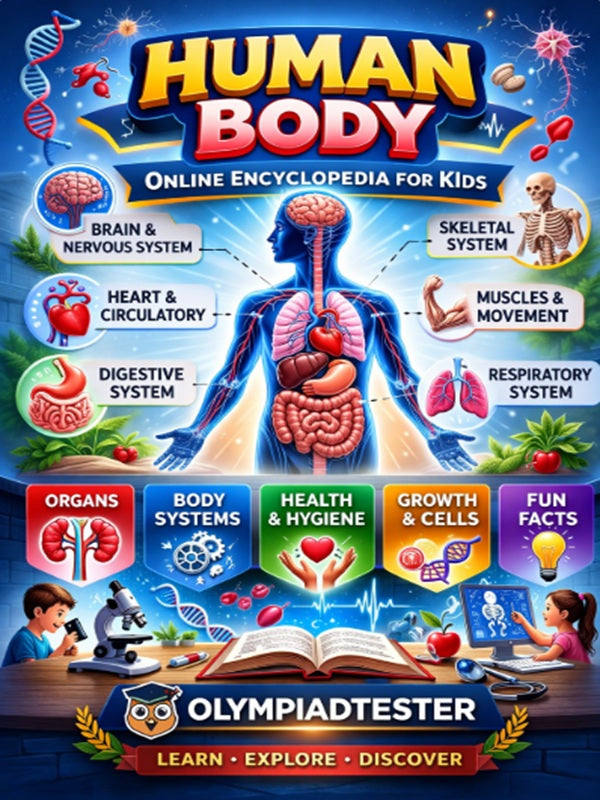
The human body is a complex biological system composed of interconnected organs, tissues, and cells that work together to sustain life. From the protective outer layer of skin to the intricate networks of nerves and bones, each part performs specialized functions that maintain balance, growth, and survival.
This section of the Olympiadtester GK Encyclopedia serves as a structured knowledge hub for exploring anatomy, physiology, body systems, and fascinating biological processes in a clear and student-friendly format.
Understanding the Human Body
The study of the human body involves anatomy (the structure of body parts) and physiology (how those parts function). Organs combine to form organ systems, and these systems interact continuously to regulate breathing, circulation, digestion, movement, and sensory responses.
Cells form tissues, tissues form organs, and organs form systems — creating a highly coordinated network that supports life.
Major Body Systems
Circulatory System
The circulatory system, powered by the heart, transports oxygen, nutrients, and hormones throughout the body via blood vessels.
Respiratory System
The respiratory system enables breathing and gas exchange, supplying oxygen to cells and removing carbon dioxide.
Digestive System
The digestive system breaks down food into nutrients that the body can absorb and use for energy, growth, and repair.
Nervous System
The nervous system controls communication between the brain, spinal cord, and the rest of the body, enabling movement, reflexes, and thought processes.
Skeletal and Muscular Systems
The skeletal system provides structure and protection, while the muscular system allows movement and coordination of the body’s parts.
Explore Human Body Fact Articles
This encyclopedia hub connects to detailed and engaging fact articles about specific human body features and processes. Popular entries include Amazing Facts About Human Nails, 20 Amazing Facts About Human Hair, and Amazing Facts About the Human Skin.
Frequently Asked Questions
What is the difference between anatomy and physiology?
Anatomy refers to the structure of body parts, while physiology explains how those parts function and interact within systems to sustain life.
Why do body systems work together?
Body systems are interconnected. For example, the respiratory system supplies oxygen, which the circulatory system transports to cells, enabling energy production and overall function.
What is homeostasis?
Homeostasis is the body’s ability to maintain stable internal conditions like temperature, hydration, and chemical balance despite external changes.
How does the human body grow and repair itself?
Growth and repair involve cellular processes such as division and regeneration, supported by systems like the endocrine and immune systems.
Explore More GK Encyclopedia Sections